Taiwan plans for maritime drone swarms using U.S. designs
Taiwan is collaborating with U.S. firms on building out maritime drone capabilities.

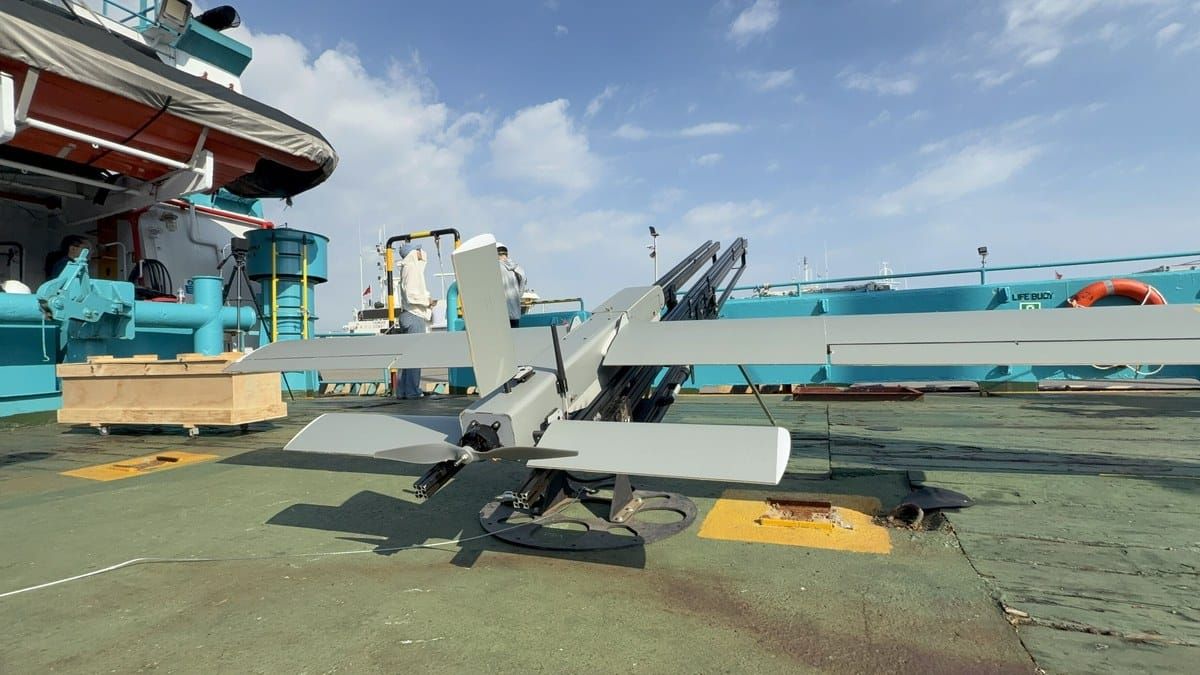
Taiwan's Ocean Affairs Council (海洋委員會), which oversees Taiwan's coast guard, is promoting a "drone swarm" system that it says will help build a smarter maritime security line. So far, the swarm has flown only in a computer simulation, even as the coast guard takes delivery of real, imported drones.
The work is research the council funds, according to its Oct. 26 release. A team at National Cheng Kung University (國立成功大學) in Tainan built flight models of three US drone designs that take off and land vertically, then cruise on wings:
- AeroVironment's JUMP 20
- Shield AI's V-BAT
- Flexrotor, made by Airbus in Bingen, Washington.
The team used multi-agent reinforcement learning, an AI technique for letting drones split up tasks and plan routes together.
The team has completed a simulated flight of 20 drones in two swarms. Next come ground tests of the control software on real flight hardware, work on a prototype and flight tests at sea, the release says, giving no dates.
Taiwan's own defense research institute has already flown a real autonomous drone team, at a smaller scale. In August, Shield AI, a US defense-tech company, and the National Chung-Shan Institute of Science and Technology (NCSIST) said they had flown three of the institute's Mighty Hornet III drones on a coordinated autonomous search.
The coast guard's newest drones, meanwhile, are imported. Shield AI says it has made its first delivery of V-BAT drones to the Coast Guard Administration (海洋委員會海巡署) and that 12 will be delivered over the coming months. Shield AI will train the coast guard's operators and maintenance staff and, with its Taiwanese partner Aerospace Industrial Development Corporation (AIDC), set up local support for the aircraft.
The coast guard's plans go beyond the V-BATs. Council minister Kuan Bi-ling (管碧玲) has said the coast guard plans about NT$2.1 billion (about US$66 million) for four classes of drone system. Even advanced equipment depends on fully trained people to operate it and make judgments, she said at a June coast guard drone contest, as reported by ETtoday.
Chinese coast guard ships have repeatedly intruded into Taiwan’s waters since early 2024. They made 117 patrols around Kinmen through May 2026, often entering restricted waters in groups of four. Activity near the Pratas Islands rose from 25 days in 2024 to 60 in 2025, and in June 2026 Chinese government vessels entered restricted waters around Taiping Island for the first time. Taiwan has also blamed Chinese-crewed ships for cutting undersea cables.
Sources: 海洋委員會 Ocean Affairs Council, Shield AI [1], [2], Airbus, AeroVironment, ETtoday
Editor: Ian Lamont