China drafts EV battery IDs as global recycling ramps up
Makers would code every EV battery and automakers would tell owners who made it, but carbon figures are only encouraged.

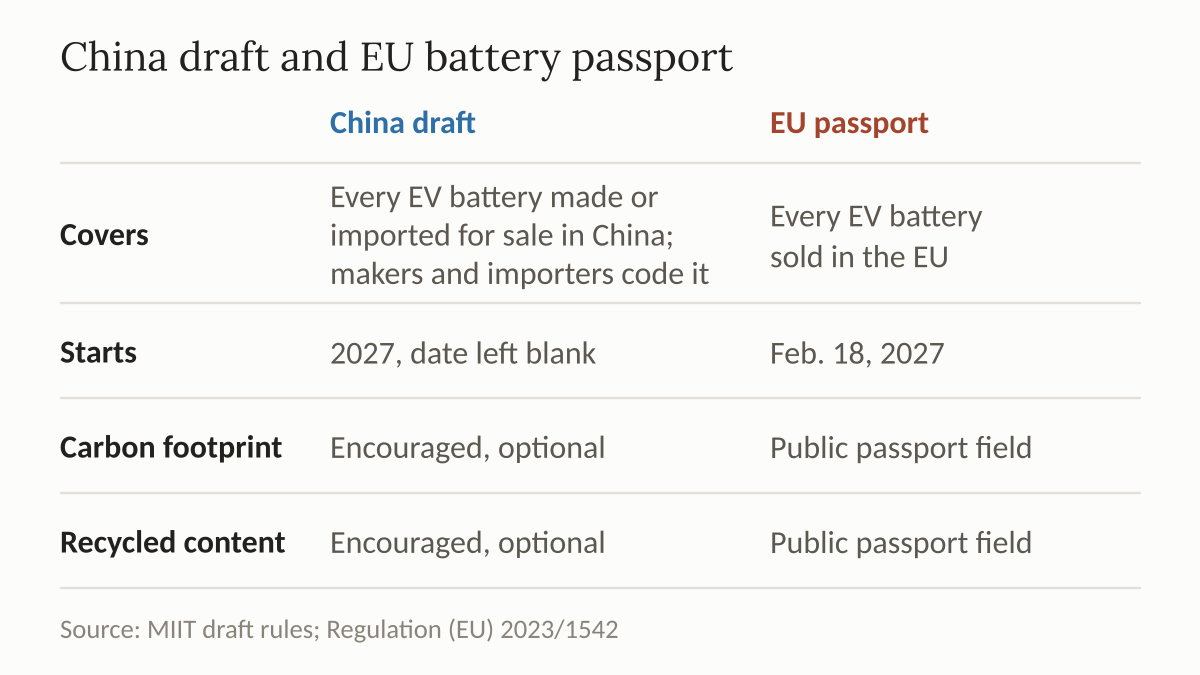
China's Ministry of Industry and Information Technology (工业和信息化部, MIIT) has drafted rules giving each battery in China's electric and plug-in hybrid vehicles (what China calls new-energy vehicles) a digital ID. The ID is a record, keyed to the battery's 24-digit code, that follows it from production to recycling.
Under the draft, published Nov. 5, battery makers, importers included, must give each battery a unique code and a label to a national standard. Automakers must upload each fitted pack's code to China's vehicle-certificate system. They must also tell owners the battery's maker, production date, warranty and cathode material. The draft would take effect on a date in 2027 that is still blank. Comments are due Dec. 6.
MIIT would run a website lookup of each battery's history. Repairers, dismantlers and recyclers must take batteries apart following the disassembly manuals they find through the lookup. Collectors must record where a battery came from when its code is missing or unreadable.
The draft carries out measures from MIIT and five other agencies, in force since April 1, 2026, which set up the ID system with rules "to be issued separately," according to the text carried by Cailian Press (财联社). Under those measures, a company that ignores the system and won't correct it faces a warning or a fine of up to 50,000 yuan (about US$7,400).
Some data would stay voluntary. Companies are only "encouraged" to calculate recycled-material shares and carbon footprints. The European Union's battery regulation requires a passport for each electric-vehicle battery on its market from Feb. 18, 2027, and its passport's public fields include carbon footprint and recycled content. By our reading, a battery maker selling in both China and the EU would have to deal with two separate record systems.
The rules arrive as battery recycling grows. China recycled more than 400,000 metric tons of retired EV batteries in 2025, up 32.9% from 2024, MIIT official Ai Chong (艾崇) said, according to Economic Information Daily (经济参考报). In January, Xinhua reported an estimate that China will generate more than 1 million metric tons of retired EV batteries in 2030.
Sources
- 工业和信息化部 Ministry of Industry and Information Technology (notice)
- 工业和信息化部 Ministry of Industry and Information Technology (draft text)
- 财联社 Cailian Press
- 经济参考报 Economic Information Daily (via Xinhua)
- EUR-Lex, Regulation (EU) 2023/1542
- 新华社 Xinhua
Editor: Ian Lamont