LX Pantos tests rack-climbing robots with South Korean and Chinese partners
One cosmetics client cut its warehouse space by about 30% after adopting robot storage and picking, according to LX Pantos.

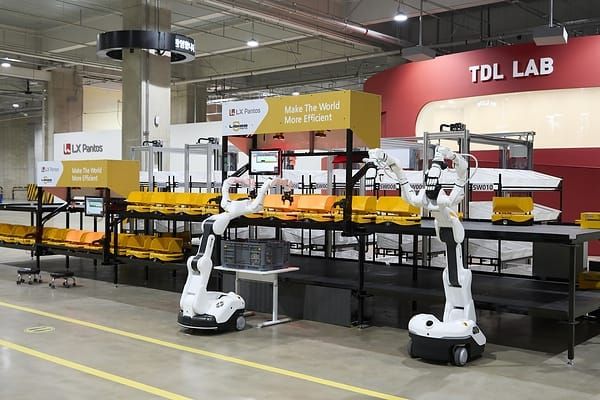
In a basement lab in Incheon, small robots climb up and down the walls of storage racks carrying boxes, then pass them to another robot that brings each one to a worker. Nearby, a large robot arm lifts two big boxes at a time, works out its own stacking order and can handle 400 boxes an hour. Staff wear smart glasses that let them check order quantities at a glance. A Korea Economic Daily (한국경제) reporter saw all of it on an Oct. 30 visit to the test lab South Korean logistics company LX Pantos (LX판토스) opened in October.
LX Pantos now plans to take that automation out of the 2,700 m2 (about 29,000 square feet) lab and into centers holding customers’ goods, the paper reported. It will spend about 76 billion won (about US$54 million) in 2027 on automation systems at its Cheongna center and others. That’s about half of its 2025 operating profit of 152.1 billion won (about US$109 million).
LX Pantos said in an Oct. 27 release that it has signed memorandums of understanding with seven technology firms since April. They include LG CNS and Chinese warehouse-robot maker Hai Robotics. The launch announcement gave no investment figure or timetable.
South Korea's largest entertainment company and a sporting-goods company, neither named, have agreed to use the Cheongna center from early 2027, the paper reported. One cosmetics client cut its warehouse space by about 30% after adopting robot storage and picking, according to LX Pantos. Eo Jae-hyeok (어재혁), an LX Pantos executive vice president, told the paper that logistics companies that can't make large capital investments now find it hard to do business with customers.
Three of the lab’s seven technology partners are Chinese: Hai Robotics (storage and picking robots), Libiao Robotics (sorting robots) and XYZ Robotics (robot arms for loading and unloading). The other four are Korean: LG CNS (systems integration and central control), Twinny (picking robots that work alongside staff), SUM (self-driving transport between floors) and Deepfine (vision systems for picking and inspection), according to LX Pantos.
In Korean warehouses, repetitive steps such as sorting are already automated, but picking and packing goods of different sizes and shapes still relies on human hands, Money Today (머니투데이) reported in September. LX Pantos's own roadmap starts with centers where people and robots work together, before fully unmanned ones.
Sources
- 한국경제 Korea Economic Daily
- LX Pantos (release via Thailand Business News)
- Container News
- 머니투데이 Money Today
Editor: Ian Lamont