Taiwan firms' plants in China make Beijing's proposed smart-factory list
Several of the seven plants carry a large share of their Taiwanese parents' business, the companies' own filings show.

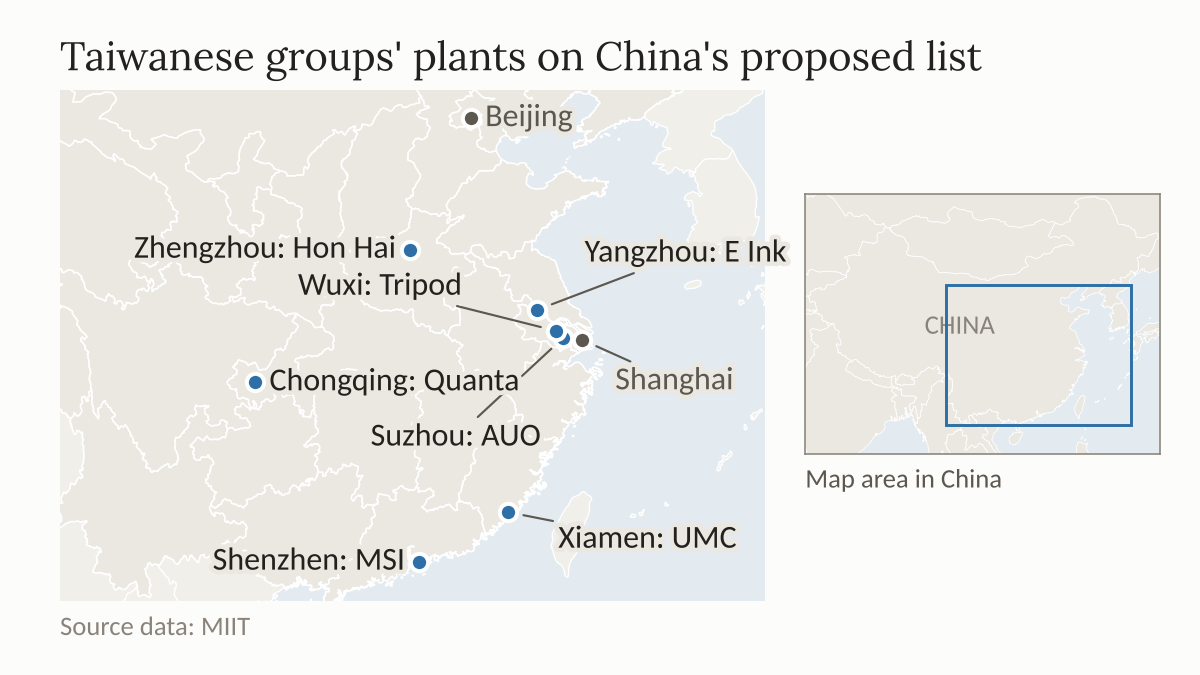
At least seven of the factories China wants to hold up as national models of automation belong to Taiwanese tech groups, including New Taipei City-based Hon Hai Precision Industry (Foxconn, 鴻海) and Taoyuan-based Quanta Computer (廣達電腦).
China's Ministry of Industry and Information Technology (MIIT, 工业和信息化部) named them among 253 projects on its proposed list of "excellence-level" smart factories, the third of four tiers in its ratings of Chinese plants. The list was posted Oct. 19, with objections taken through Oct. 26.
The project titles say what each plant makes:
- AUO (友達光電), based in Hsinchu, Taiwan: display modules in Suzhou, Jiangsu province, at its Suzhou subsidiary (友达光电(苏州)).
- E Ink (元太科技), based in Hsinchu: color e-paper displays in Yangzhou, Jiangsu, at its Yangzhou subsidiary (川奇光电科技(扬州)).
- Tripod Technology (健鼎科技), based in Taoyuan, Taiwan: high-density interconnect circuit boards for AI computing equipment in Wuxi, Jiangsu, at its Wuxi subsidiary (健鼎(无锡)电子).
- United Microelectronics Corporation (UMC, 聯華電子), based in Hsinchu: integrated circuits in Xiamen, Fujian province, at United Semiconductor (Xiamen) (联芯集成电路制造(厦门)).
- Hon Hai: precision manufacturing of smart devices ("smart terminals" in the project's title) in Zhengzhou, Henan province, at its Zhengzhou subsidiary (鸿富锦精密电子(郑州)).
- Micro-Star International (MSI, 微星科技), based in New Taipei City: high-end motherboards and graphics cards in Shenzhen, Guangdong province, at its Shenzhen subsidiary (恩斯迈电子(深圳)).
- Quanta: notebook PCs in Chongqing, in southwest China, at its Chongqing subsidiary (达丰(重庆)电脑).
AUO, E Ink, UMC, Quanta and MSI each own 100% of their unit through other group companies, according to their latest financial reports (AUO, E Ink, UMC). Hon Hai's report and a Tripod filing call their units subsidiaries.
Several PRC plants are central to their Taiwan parent companies. Hon Hai's Zhengzhou unit sold NT$815.9 billion (about US$25 billion) of goods to another Hon Hai company in the first half of 2026, equal to 18% of Hon Hai's revenue in that period, its report says. In the same six months, Quanta itself, not counting its subsidiaries, bought about a fifth of its goods, NT$276.4 billion (about US$8.5 billion), from the Chongqing plant, which made almost all its sales to Quanta, its report shows. MSI itself bought 57% of its goods in that period, NT$40.3 billion (about US$1.2 billion), from its Shenzhen plant, its report shows.
Sources: 工业和信息化部 MIIT (2026 excellence-level smart factory proposed list, PDF), 工业和信息化部 MIIT (Department of Equipment Industry I notice), 友達光電 AUO (Q2 2026 consolidated financial report), 元太科技 E Ink Holdings (Q1 2026 consolidated financial report), 聯華電子 UMC (Q2 2026 consolidated financial report, MOPS), UMC (Form 20-F Exhibit 8.1, SEC), 鴻海 Hon Hai (Q2 2026 consolidated financial report, MOPS), 廣達電腦 Quanta Computer (Q2 2026 consolidated financial report, MOPS), 微星科技 Micro-Star International (Q2 2026 consolidated financial report, MOPS), 臺灣證券交易所 TWSE (Tripod Technology company profile)
Editor: Ian Lamont