Parsing China's atypical robot output data for September
YoY growth rates dropped sharply even while output held steady. There's a reason for that.

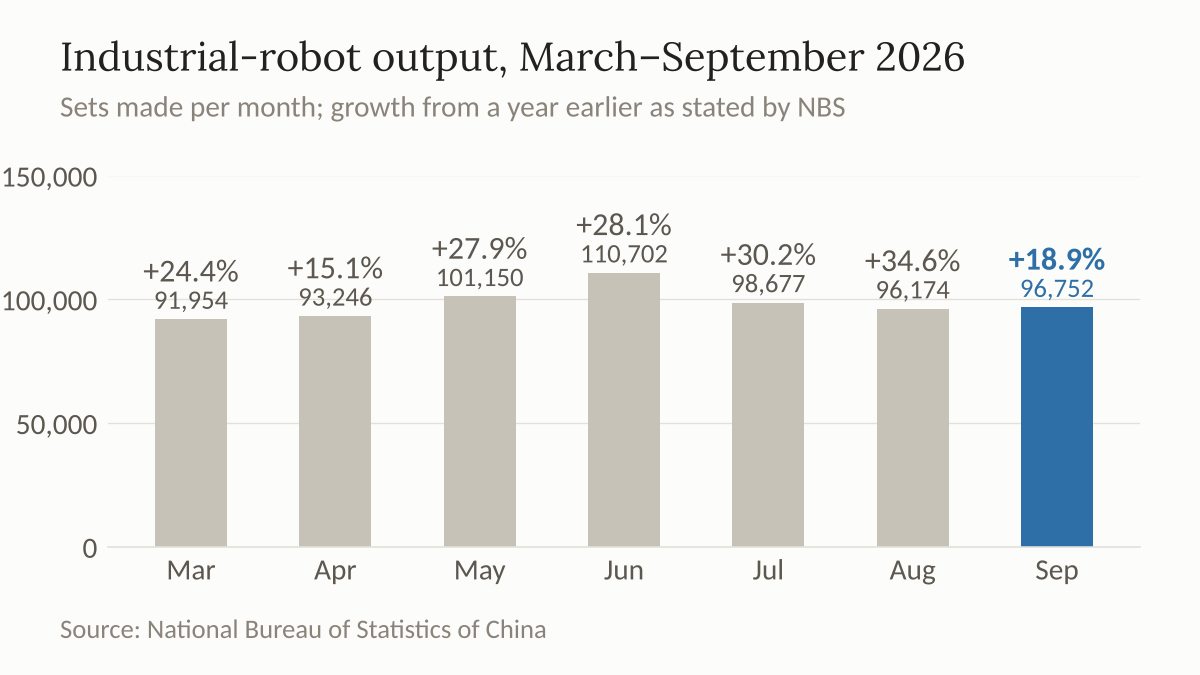
China's larger industrial firms made 96,752 industrial robots in September, about as many as in August, according to monthly output figures from China's National Bureau of Statistics (NBS, 国家统计局). However, growth from a year earlier slowed sharply, to 18.9% after strong YoY expansion over the summer, including 34.6% growth in August.
The September 2026 numbers may not be as bad as they seem at first glance. The slowdown mainly reflects a jump in output. By our calculation from the figures NBS published at the time, September 2025 output was about a fifth higher than August 2025's. NBS calculates its growth rates against last year's output from a group of firms matched as closely as possible to this year's, so its rates differ from a straight comparison with last year's published figures.
Over the longer run, growth held up. Industrial-robot output rose 29.1% in the first nine months of 2026, to 794,781. NBS highlighted that figure, alongside 3D printing equipment and lithium-ion batteries, in its review of the economy's first three quarters.
Service robots, which NBS counts separately, followed a similar pattern: output held at August's level, about 1.66 million, but NBS's growth rate turned negative, at −17.8%, its first drop this year. Last year's published figures show service-robot output also jumped in September 2025. Machine tools, a separate category, kept growing: output of metal-cutting machine tools rose 12.5% in September from a year earlier, to about 80,000.
The figures cover only industrial firms with annual revenue from their main business of RMB 20 million (about US$2.8 million) or more. By our calculation, NBS's nine-month total for industrial robots is about 31,000, or nearly 4%, lower than its January–August total plus September's figure, and the release doesn't say why.
Sources: 国家统计局 National Bureau of Statistics of China [1], [2], [3], [4], [5], [6], [7], [8], [9], [10], [11]
Editor: Ian Lamont